
Roulette rules, payouts and house edge.
A wheel, a ball, and a bet on where it stops. The rules are simple; the only thing that really varies between tables is how many zeros the wheel carries, and that changes everything.
The wheel and the table
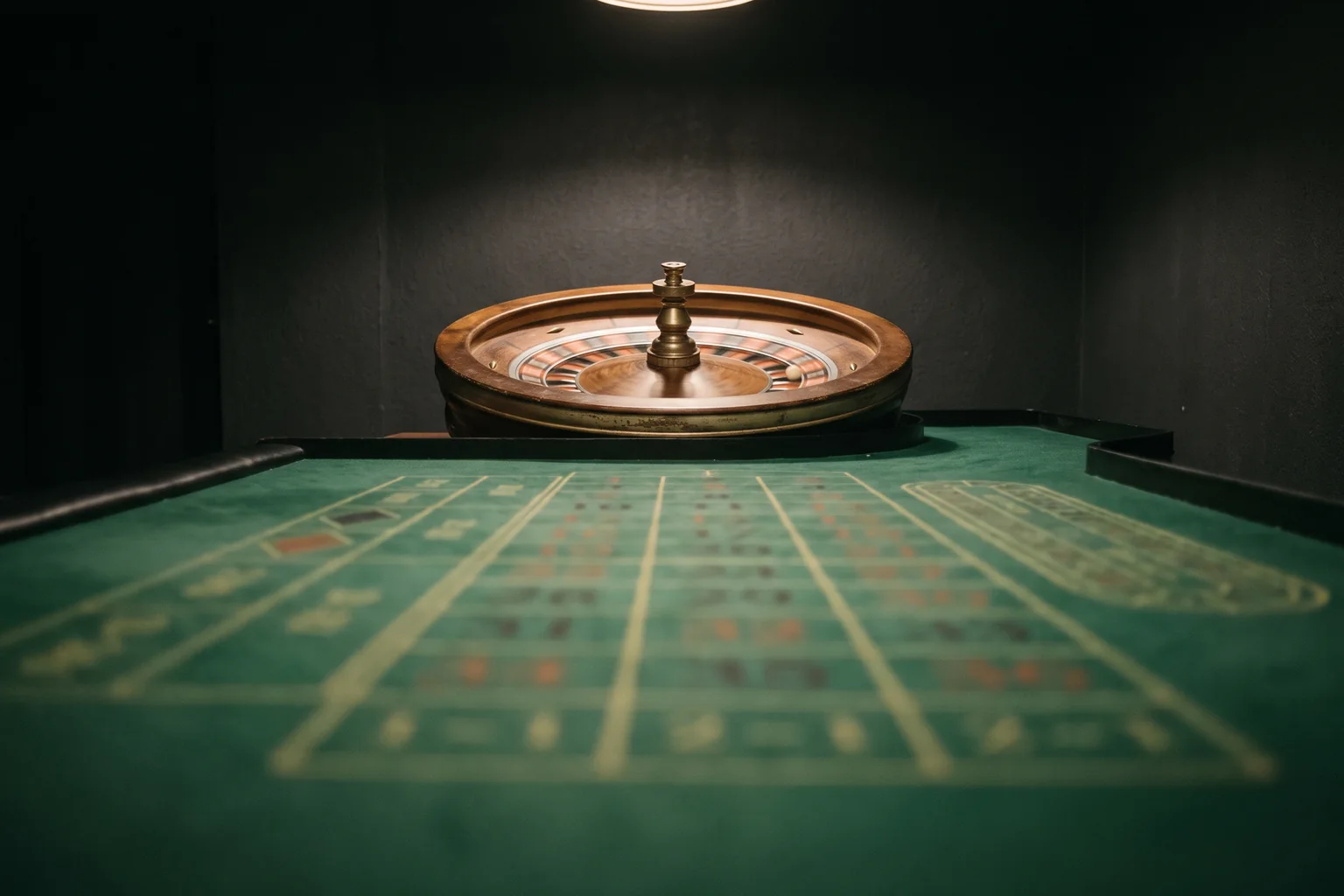
A European wheel has 37 pockets: 1 to 36, plus a single green zero. An American wheel adds a second green pocket, the double zero, for 38. The numbers 1 to 36 split evenly, eighteen red and eighteen black; the zeros are green and belong to neither.
The numbers are not arranged in order around the rim. They are laid out so that red and black, high and low, odd and even alternate as much as possible, which is why the wheel looks scrambled next to the tidy grid on the betting layout.
European
37 pockets
- Numbers
- 1-36 + 0
- House edge
- 2.70%
American
38 pockets
- Numbers
- 1-36 + 0 + 00
- House edge
- 5.26%
That one extra pocket on the American wheel is the whole difference between the two games. The bets and the payouts are identical; there is simply one more way to lose.
How a round plays out
- 1. Betting opens
 Chips go down on the layout: any mix of inside and outside bets, in any combination.
- 2. The wheel spins
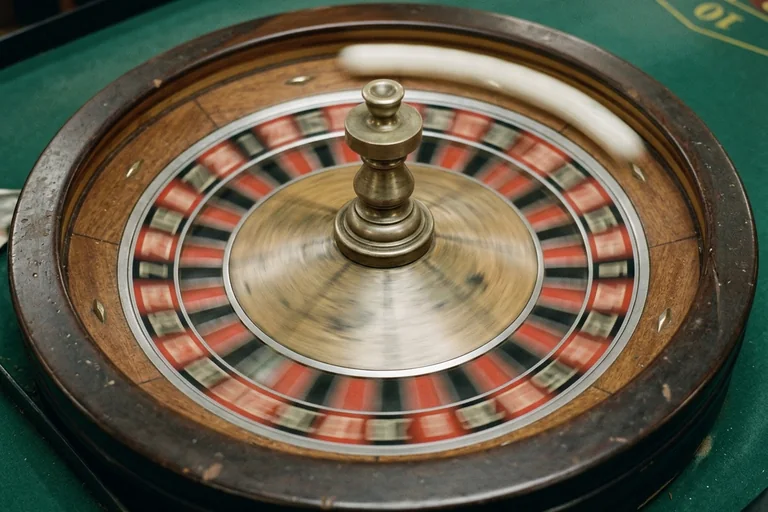 The dealer sets the wheel turning and releases the ball against the direction of the spin.
- 3. No more bets
 Betting closes while the ball is still travelling, so no one can act on where it is slowing.
- 4. The ball lands
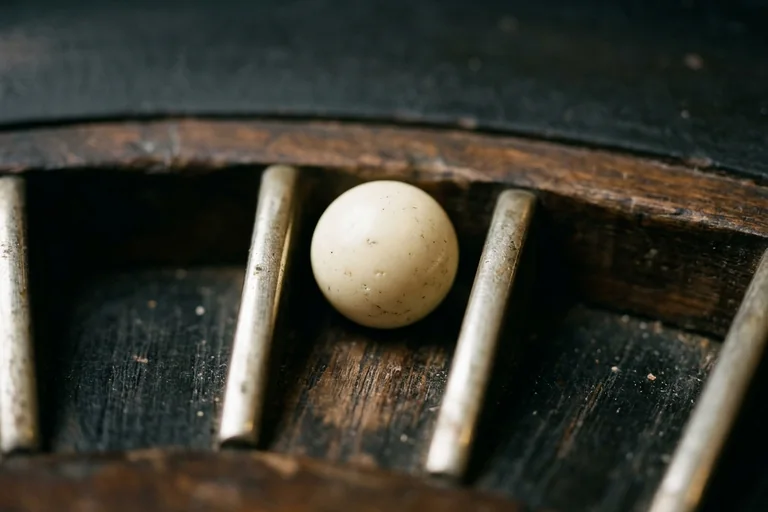 It drops into a pocket, and that number is the result for every bet on the table.
- 5. The table settles
 The winning number is marked, losing chips are cleared, winners are paid, and the next round opens.
Every bet and what it pays
Bets divide into two families. Inside bets sit on the numbers themselves and pay long odds; outside bets cover large groups and pay short ones. On a European wheel every bet in this table carries the same 2.70% house edge. The payouts are scaled so that no bet is better than another.
| Bet | Covers | Pays | Wins (European) |
|---|---|---|---|
| Straight up | 1 number | 35:1 | 2.70% |
| Split | 2 numbers | 17:1 | 5.41% |
| Street | 3 numbers | 11:1 | 8.11% |
| Corner | 4 numbers | 8:1 | 10.81% |
| Six line | 6 numbers | 5:1 | 16.22% |
| Column | 12 numbers | 2:1 | 32.43% |
| Dozen | 12 numbers | 2:1 | 32.43% |
| Red / Black | 18 numbers | 1:1 | 48.65% |
| Odd / Even | 18 numbers | 1:1 | 48.65% |
| High / Low | 18 numbers | 1:1 | 48.65% |
Where each bet sits on the table: inside bets on the number grid, outside bets along the bottom and the side.
La Partage and En Prison
French tables add a rule that softens the zero, and it applies only to the even-money bets: red/black, odd/even, high/low.
Under La Partage, when the ball lands on zero those bets lose exactly half their stake and the other half is returned immediately. Under En Prison the stake is held instead: it stays on the table for one more spin, and if that spin wins, the original stake comes back with no winnings attached. Lose, and it is gone.
Either rule halves the house edge on those bets, from 2.70% to about 1.35%. It is the single biggest rules difference in roulette, and it costs nothing to look for.
Zero hits, and half your even-money stake comes straight back. The other half goes to the house, and the round is over.
Zero hits, and the stake stays on the table for one more spin. Win that spin and the stake returns with no winnings; lose and it is gone.
Surrender The American equivalent, found mainly in Atlantic City. Even-money bets lose half on zero or double zero, which brings their edge down to 2.63%.
The house edge, plainly
- French · La PartageEven-money bets with La Partage or En Prison1.35%
- EuropeanStandard European, every bet2.70%
- American5.26%
- American basket bet7.89%
The edge comes from one place: the payouts are calculated as though the zero did not exist. A straight-up number is one chance in 37 on a European wheel but pays 35:1, and that gap is the house's margin: 2.70% of everything staked, over time.
Add the double zero and the same gap widens to 5.26%. The one bet that is worse than the rest is the American five-number basket on 0, 00, 1, 2 and 3, which carries 7.89%.
These numbers are fixed by the rules. No betting pattern, staking system or run of results changes them.
How Roulette Streaks watches it
Roulette is where the streak counting is most direct. Roulette Streaks tracks consecutive runs on red, black, odd, even, high, low, each dozen and each column, and the absence of dozens and columns (how long since one last landed).
Counting starts at seven. The Telegram channels post an alert when a red or black run reaches 10 in a row, and personal alerts use a threshold you choose. The alert reports the run and its rarity. It does not suggest a bet.
Frequently asked
- What is roulette?
- A wheel numbered 0 to 36 (plus a second zero on American tables) and a bet on which pocket the ball stops in. Bets range from a single number paying 35:1 to red or black paying evenly, and the house edge is 2.70% on a European wheel.
- Is European or American roulette better to play?
- European, without qualification. The games are identical apart from the extra green pocket, which raises the house edge from 2.70% to 5.26%, roughly double the long-run cost for exactly the same bets.
- Does a long run of red make black more likely?
- No. The wheel has no memory, and each spin is independent of every spin before it. After ten reds the chance of black on the next spin is the same as it always was. That independence is precisely why a long run is statistically unusual.
- Which roulette bet has the best odds?
- On a European wheel every standard bet carries the same 2.70% edge, so none is mathematically better. They differ only in how often they win and how much they pay. The exception is a French table with La Partage, where even-money bets drop to about 1.35%.
- What does La Partage mean?
- It means that when the ball lands on zero, even-money bets lose only half their stake instead of all of it. It halves the house edge on those bets to about 1.35%.