
Baccarat Pattern Reading: What the Scoreboards Really Show
How the bead plate and big road record baccarat results, why the human eye finds patterns in them, and the streak probabilities worked out from the standard odds.
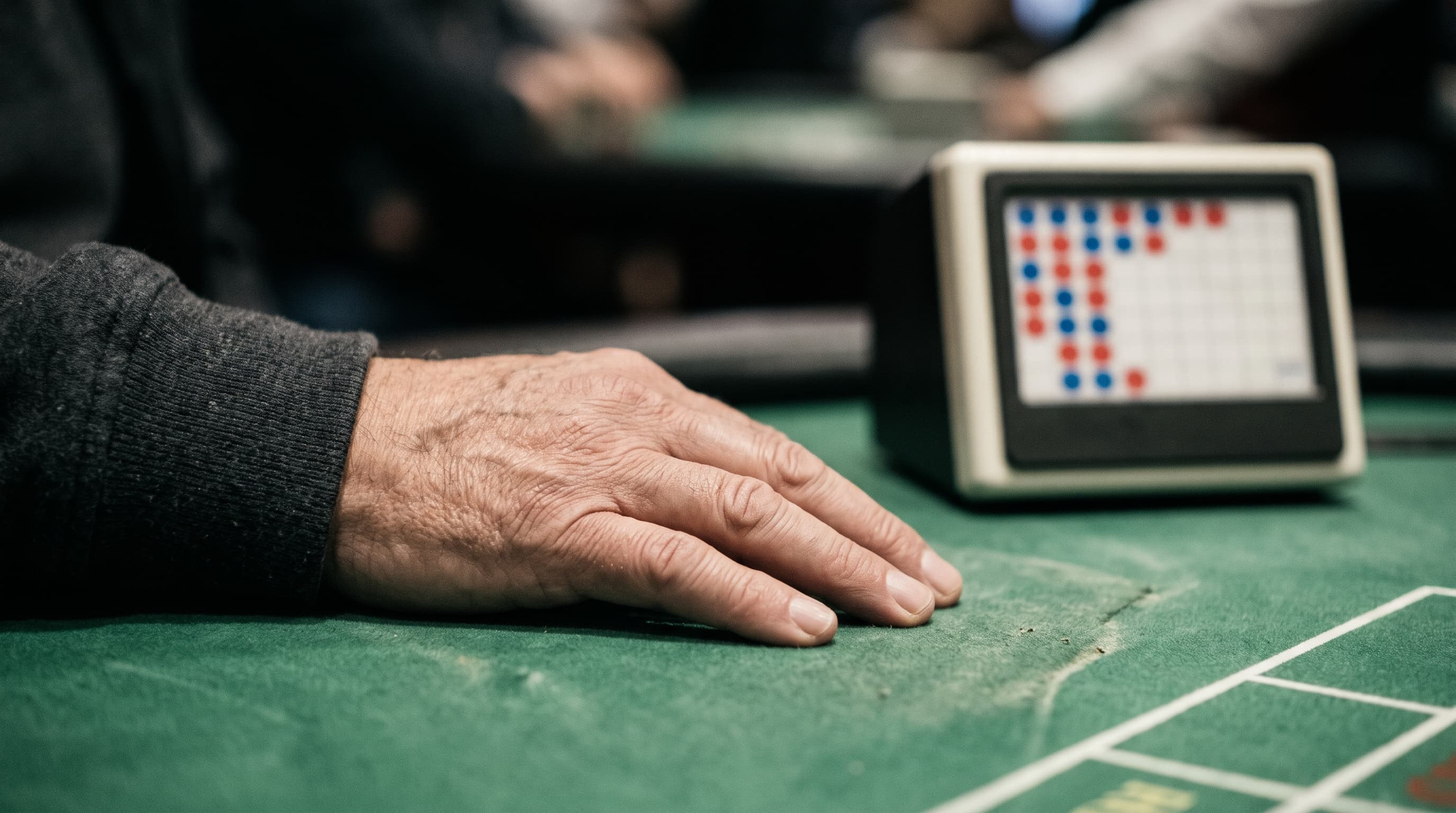
Every live baccarat table has a screen full of coloured dots, and every player eventually asks whether a baccarat pattern on that screen means something. Short answer: the boards record results accurately, but a pattern on them does not tell you what the next hand will be. This guide explains how the two main boards work, why patterns look real, and what the streak probabilities actually are. Baccarat is for adults only (18+).
How the Baccarat Scoreboards Work
Two boards do most of the work.
Bead Plate
The bead plate lists results in order of play. Each hand fills one cell, going down a column of six rows and then starting the next column. Banker is usually red, player blue and tie green. It is a plain log with nothing added.
Big Road
The big road starts a new column each time the winner changes. Consecutive banker wins stack down one column, and when player wins, the next column starts. Ties are normally marked with a slash on the previous result instead of getting their own cell. So the big road shows runs of the same winner as columns.
The smaller derived boards (the big eye boy, small road and cockroach pig) are calculated from the big road. They rearrange the same results and add no information about the cards.
Players have names for what they see. A long column is often called a dragon, and a stretch of alternating results is called a chop. The names are descriptive. They do not describe anything the table is about to do.
Why People See a Baccarat Pattern
People are good at spotting structure, and random sequences contain more of it than intuition expects. Three habits do most of the damage:
- Remembering long runs and forgetting the rest. A column of nine sticks in memory. The dozens of two-hand runs around it do not.
- Reading meaning into any shape. Six alternating results look planned. A specific mixed sequence like banker, player, player, banker, player, banker looks random. Both are equally likely, as the maths below shows.
- Expecting a run to "correct" itself. After a long banker run, a switch feels due. That is the gambler's fallacy, covered in why winning streaks can fool you.
Baccarat Streak Probabilities You Can Calculate
Start with the standard 8-deck odds from our banker vs player article: banker 45.86%, player 44.62%, tie 9.52%. The boards mostly care about decided hands, so set ties aside:
- Banker share of decided hands: 50.68% (from the unrounded probabilities; 0.4586 ÷ 0.9048 gives 50.69%)
- Player share: 49.32%
The result is close to a coin flip with a slight banker lean. Everything below follows from those two numbers, treating each decided hand as independent.
Specific Sequences of Six Hands
The probability of a sequence is the product of its steps. Use B for banker (0.5068) and P for player (0.4932).
| Six decided hands | Calculation | Probability |
|---|---|---|
| B B B B B B | 0.5068⁶ | 1.69% |
| P P P P P P | 0.4932⁶ | 1.44% |
| B P B P B P | 0.5068³ × 0.4932³ | 1.56% |
| B P P B P B | 0.5068³ × 0.4932³ | 1.56% |
A "dragon" of six and a perfect chop of six are about as likely as each other. Adding both chop directions gives 3.12% (B P B P B P or P B P B P B). Adding both single-colour runs gives 3.13%. A mixed-looking sequence has exactly the same probability as the tidy chop.
How Often the Winner Changes
The chance that two consecutive decided hands have different winners is:
2 × 0.5068 × 0.4932 = 49.99%
So about half of all big road columns are a single dot long. Average column length works out to 1 ÷ (1 − 0.5068) = 2.03 for banker columns and 1 ÷ (1 − 0.4932) = 1.97 for player columns.
A shoe of 8 decks deals around 80 hands, with roughly 72 decided. The expected number of columns is 1 + 71 × 0.4999 = about 36.5. A typical big road is a mix of many short columns with a few longer ones. Our banker vs player article has the table for longer runs, so I won't repeat it here.
Is There a Strategy to Baccarat That Uses Patterns?
Pattern systems come in two flavours: follow the run ("ride the dragon") or fade it ("bet the switch"). Check each against the numbers.
After any run, the next decided hand is banker 50.68% of the time and player 49.32%, because the cards do not know what came before. "Follow the run" and "fade the run" therefore both land on whichever side you chose, with the same odds as any other hand.
Take an example. Suppose you only bet banker after a column of four or more. Those bets face the same 1.06% house edge as any banker bet. You have chosen when to bet, not how likely you are to win. Expected loss is still the edge times the amount staked, whichever hands you pick. The same applies to player and to every betting system. Our baccarat betting systems guide works through five of them.
Does the Shoe Change the Odds?
Strictly, yes. Baccarat is dealt without replacement from a finite shoe, so each card dealt slightly changes what is left, and the true probability of the next hand drifts a little from the starting figures.
In practice the shift is tiny, and it does not help a player for three reasons:
- It is small. With eight decks in play, removing a handful of cards moves the odds very little, and the house edge on the best bets is over 1%.
- A scoreboard does not record it. The effect depends on which cards left the shoe, and the bead plate and big road only note who won each hand. A run of banker wins says almost nothing about the cards used.
- It needs exact tracking. Following card values accurately through a live shoe, while hands are dealt quickly, is demanding, and the benefit stays tiny for the effort.
Roulette Streaks shows live streak data and Telegram alerts for tables. Its baccarat feed is currently offline, so the baccarat page shows stored past results you can compare with the maths above. It does not make a streak more or less likely to continue.
FAQ
Is there a strategy to baccarat that works?
There is a strategy for losing less: pick the bet with the lowest edge (banker at 1.06%, player at 1.24%) and stake less in total. No strategy removes the edge. Nothing based on patterns, boards or bet sizing changes the odds of the next hand.
How to win at baccarat every time?
You cannot. Banker wins about 45.86% of hands and player 44.62%, so any bet loses a large share of the time. Anyone offering a method that wins every time is selling something that the arithmetic rules out.
What is a baccarat pattern like a dragon or chop?
A dragon is a long run of the same winner. A chop is a run of alternating winners. Both occur in random sequences, and at six decided hands each has about a 3.1% chance of starting on a given hand.
Can the big road predict the next hand?
No. It records what happened. Each decided hand is banker about 50.68% of the time and player about 49.32%, whatever the board shows.
*Play only if you are 18 or over, and only with money you can afford to lose. If gambling stops being fun, take a break and contact a local support service.*