
Sic Bo Strategy Guide: Dice Probabilities and Which Bets to Choose
Every sic bo bet's house edge computed from the 216 dice outcomes, from Small/Big at 2.78% to totals of 9 or 12 at 18.98%, plus why dice tracking fails.
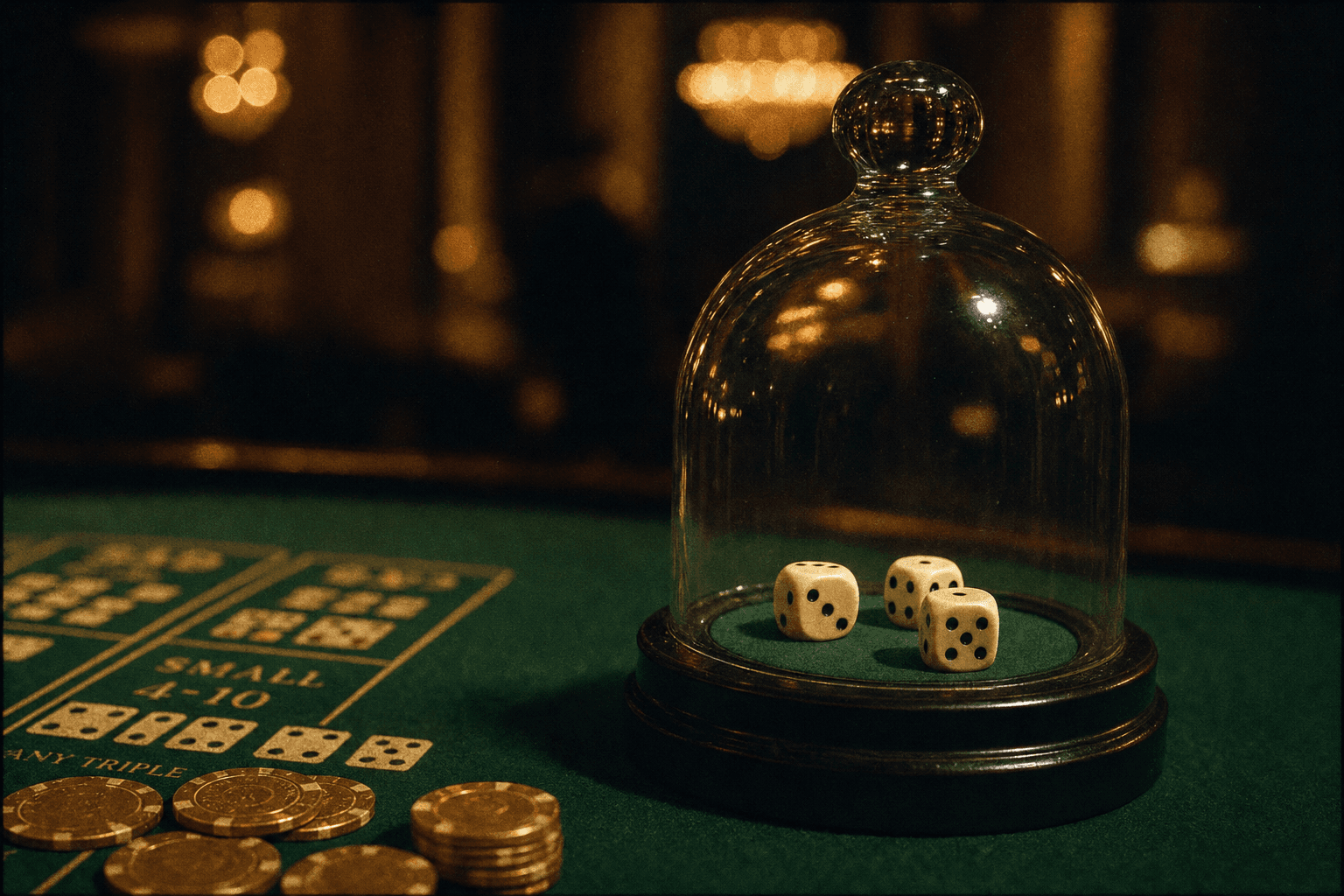
Sic bo looks like a game of dozens of choices, but the math sorts those choices fast. Three dice produce a fixed set of outcomes, and every bet on the layout carries a house edge you can compute to the decimal. This guide does that computation, bet by bet, so you can see which wagers cost the least and which ones cost the most.
How Sic Bo Works: Three Dice, 216 Outcomes
The dealer shakes three standard six-sided dice in a covered container, and you bet on what they show. Each die has 6 faces, so three dice give 6 × 6 × 6 = 216 ordered outcomes, each with a probability of 1/216.
Many of those outcomes look the same on the table. A roll of 1-2-3 and a roll of 3-2-1 count as the same result for every bet. When you group the 216 ordered outcomes by the set of faces showing, you get 56 distinct combinations:
- Triples (6 combinations): all three dice match, such as 4-4-4. Each one has 1 ordered way to appear.
- Doubles with a third face (30 combinations): such as 5-5-2. Each one has 3 ordered ways.
- Three different faces (20 combinations): such as 1-3-6. Each one has 6 ordered ways.
Check: 6 × 1 + 30 × 3 + 20 × 6 = 216. Strategy guides that quote 210 outcomes or treat the 56 combinations as equally likely will give you wrong odds. A specific triple has 1 way in 216. The combination 1-3-6 has 6 ways in 216, six times as likely.
Sic Bo Odds: How Often Each Total Appears
Most bets depend on the sum of the three dice, which runs from 3 to 18. The sums cluster in the middle, because more dice arrangements add up to 10 or 11 than to 4 or 17.
| Total | Ways (of 216) | Probability |
|---|---|---|
| 3 or 18 | 1 | 0.46% |
| 4 or 17 | 3 | 1.39% |
| 5 or 16 | 6 | 2.78% |
| 6 or 15 | 10 | 4.63% |
| 7 or 14 | 15 | 6.94% |
| 8 or 13 | 21 | 9.72% |
| 9 or 12 | 25 | 11.57% |
| 10 or 11 | 27 | 12.50% |
The table is symmetric. A total of 10 has exactly the same chance as 11, and 4 the same as 17. Every number in the next section comes from these counts.
Sic Bo House Edge for Every Common Bet
Paytables vary by casino and by live studio, so always read the payout panel before you bet. The figures below use a widely used paytable, listed in the "Pays" column. The house edge is the share of each bet the casino keeps on average over the long run.
| Bet | Wins when | Winning ways (of 216) | Pays | House edge |
|---|---|---|---|---|
| Small / Big | Total 4-10 / 11-17, no triple | 105 | 1:1 | 2.78% |
| Single number | Chosen face shows on 1, 2 or 3 dice | 75 / 15 / 1 | 1:1 / 2:1 / 3:1 | 7.87% |
| Any triple | Any three of a kind | 6 | 30:1 | 13.89% |
| Specific triple | One chosen three of a kind | 1 | 180:1 | 16.20% |
| Specific double | Chosen face on at least 2 dice | 16 | 10:1 | 18.52% |
| Two-dice combination | Two chosen different faces both show | 30 | 5:1 | 16.67% |
| Total 4 or 17 | Exact sum | 3 | 60:1 | 15.28% |
| Total 5 or 16 | Exact sum | 6 | 30:1 | 13.89% |
| Total 6 or 15 | Exact sum | 10 | 17:1 | 16.67% |
| Total 7 or 14 | Exact sum | 15 | 12:1 | 9.72% |
| Total 8 or 13 | Exact sum | 21 | 8:1 | 12.50% |
| Total 9 or 12 | Exact sum | 25 | 6:1 | 18.98% |
| Total 10 or 11 | Exact sum | 27 | 6:1 | 12.50% |
Here is how one row works. The Small bet wins on 105 of 216 outcomes and loses on the other 111, which include the triples 2-2-2 and 3-3-3 that fall inside the 4-10 range. Your average result per 1 unit staked is (105 − 111) / 216 = −6/216, a house edge of 2.78%.
Some tables change the single-number triple payout from 3:1 to 12:1. That cuts its edge to 3.70%. Other tables pay different amounts on the totals. When the numbers differ from this table, the edge differs too, and you can recompute it the same way: multiply each payout by its number of winning ways, subtract the losing ways, and divide by 216.
Which Sic Bo Bets to Avoid
The bets with large payouts carry the highest edges. Under the paytable above, eight bet types cost more than 13% of every unit you stake:
- Specific double (18.52%): pays 10:1 on a 16-in-216 chance. Fair odds would be 12.5:1.
- Total 9 or 12 (18.98%): the worst bet on this layout. It wins 25 times in 216 but pays the same 6:1 as 10 and 11, which win 27 times.
- Specific triple (16.20%): 180:1 looks generous, but the fair payout for a 1-in-216 event is 215:1.
- Two-dice combination and totals 6 or 15 (16.67%): both pay well below fair odds.
- Totals 4 or 17 (15.28%): 60:1 against a 3-in-216 chance, where fair odds would be 71:1.
- Any triple and totals 5 or 16 (13.89%): both hand the casino close to 14 cents per dollar.
You may read that some sic bo wagers carry "3%" and others "15%." The exact spread runs from 2.78% to 18.98%, which makes the cheapest bet nearly seven times cheaper than the most expensive one.
For comparison, a single-zero roulette wheel carries a 2.70% edge on every standard bet. Our roulette odds and house edge guide shows how that figure works.
The Best Sic Bo Strategy: Small and Big
If your goal is to lose the least per unit wagered, Small and Big are the answer. At 2.78%, they cost about 6 times less than a specific triple and nearly 7 times less than a 9 or 12.
These bets do not have a positive edge. Over 100 rolls at 10 units each, a Small bettor can expect to lose about 27.8 units. A specific-triple bettor making the same 100 bets can expect to lose about 162 units.
No betting sequence changes this. Raising your stake after a loss, switching from Big to Small after a run of Bigs, or waiting for a total that "hasn't come up" all leave each roll's odds where they were. The dice have no memory. Our article on why winning streaks can fool you explains why clusters of results appear in random sequences and why they carry no forecast.
Can You Spot Clustering or a Favorable Sic Bo Table?
Some guides tell players to track recent rolls and shift their bets toward results that seem to cluster. Others claim monitoring can find "favorable tables." Neither holds up. Each roll of fair dice is independent, so a table that produced many Bigs in the last hour has the same 105-in-216 chance of a Big on the next roll.
The only way a table could favor you is if its dice were physically defective. That leads to the next question: could you detect such a defect?
Dice Quality and Table Integrity in Live Sic Bo
Casinos use precision dice, and regulators in licensed markets require games and equipment to be tested. Land-based tables use a covered shaker, and live dealer sic bo games use automated shakers that agitate the dice inside a closed dome. The dealer does not throw the dice by hand.
Suppose a die did have a defect that raised the chance of a six from 16.67% to 18%. That would be a large defect by manufacturing standards. Here is what a player would see:
- In 300 rolls: three dice give 900 faces. A fair game produces about 150 sixes, with a standard deviation of about 11.2. The defective die raises the expectation to about 162, a gap of roughly one standard deviation. Fair dice reach 162 sixes or more about 15% of the time, so the count tells you nothing.
- To detect it with 80% reliability: you would need around 6,100 die faces, or about 2,000 rolls, and that assumes you knew in advance which face to test.
- Even then, the edge would stay negative on most bets: with that six-favoring die, a single-number bet on 6 still carries about a 1.1% house edge. Big would shift to a player edge of about 0.24%, small enough that ordinary swings would hide it for thousands of rolls.
A few hundred rolls of notes cannot separate a defective table from a fair one. The same logic applies to roulette, which we cover in can a roulette wheel have a bias.
Bankroll Management for a High-Variance Game
The house edge tells you the average cost. Variance tells you how wide the swings around that average will be, and in sic bo the swings depend on the bet.
| Bet | House edge | Std. deviation per unit |
|---|---|---|
| Small / Big | 2.78% | 1.00 |
| Any triple | 13.89% | 5.09 |
| Specific triple | 16.20% | 12.29 |
A specific triple wins once in 216 rolls on average. The chance of going 216 rolls without seeing it is 36.7%, and the chance of going 500 rolls without it is 9.8%. A bankroll sized for a few dozen bets can disappear long before the win arrives.
Some practical rules follow from these numbers:
- Set a session budget first: decide what you can afford to lose and stop when it is gone.
- Size bets small relative to the budget: on Small or Big, a 100-roll session at 10 units has an expected loss of about 28 units but a standard deviation of about 100 units.
- Treat long-shot bets as entertainment cost: a 180:1 payout comes with a 16.20% price.
- Set a time limit: live studios deal round after round, and your expected loss grows with every bet.
If gambling stops feeling like entertainment, free and confidential help is available from BeGambleAware, GamCare, and the National Council on Problem Gambling.
Key Takeaways
- Three dice produce 216 equally likely ordered outcomes, which group into 56 distinct combinations of unequal probability.
- Small and Big carry the lowest house edge on a standard sic bo table at 2.78%.
- Specific doubles (18.52%) and totals of 9 or 12 (18.98%) are among the most expensive bets under a common paytable.
- Tracking clusters or "favorable tables" cannot change the odds of the next roll, and a few hundred rolls cannot reveal a defective die.
- Paytables vary, so read the payout panel and recompute the edge when the numbers differ.
Keep Reading
- Best baccarat strategy: banker vs player odds
- How to predict roulette numbers: hot and cold numbers explained
- Why winning streaks can fool you
- Can a roulette wheel have a bias?
- Why a 90% win rate doesn't always mean you have an edge
- Roulette odds, streak probability and house edge
Golden Zero tracks live roulette and card-game results with streak alerts, and whatever game you play, keep it within limits you can afford.