
Is Roulette Rigged? Can a Roulette Wheel Really Have a Bias?
Roulette wheels are designed to be random, but physical imperfections can sometimes create measurable deviations. Here’s how wheel bias is detected and why thousands of spins matter.
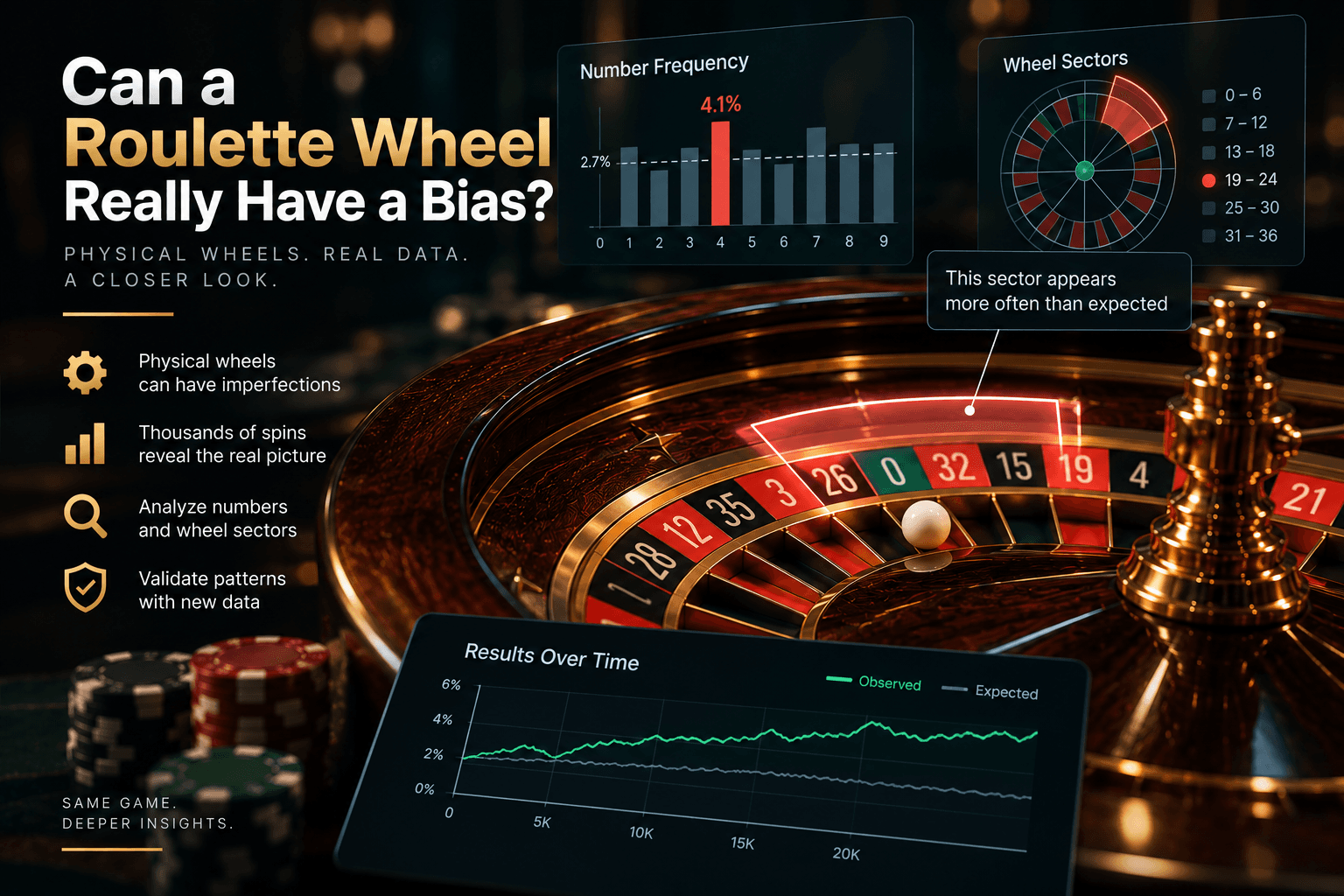
Roulette is designed to produce random results.
But a physical roulette wheel is still a mechanical system.
It contains moving parts, experiences thousands of spins, and can develop tiny physical differences over time.
So an interesting question appears:
Can those differences become measurable in the results?
And if they can, is the roulette wheel rigged? Not usually. A biased roulette wheel comes from wear and small defects far more often than from cheating.
What Is a Biased Roulette Wheel?
A perfectly balanced roulette wheel should produce each number with roughly the same probability over a sufficiently large number of spins.
On a European wheel, there are 37 pockets.
The theoretical probability of any individual number is:
1 / 37 ≈ 2.70%
Real results will never match this distribution perfectly.
Some numbers will appear more often. Others will appear less often.
Usually, that's simply normal variance.
A wheel becomes interesting when a deviation is unusually large and continues appearing as more independent data is collected.
What Could Create a Physical Bias?
A physical wheel contains many components.
Small differences can theoretically come from:
- wear on individual pockets
- slight wheel imbalance
- differences in frets or separators
- mechanical imperfections
- changes caused by maintenance
- ball or rotor behaviour
These effects don't automatically create a useful bias.
The statistical evidence still needs to show that something unusual is actually happening.
Why Thousands of Spins Matter
Imagine one number appears 6 times during 100 spins.
That might look unusual.
But 100 spins provide very little information about a wheel containing 37 possible outcomes.
Now imagine the same area of the wheel continues appearing more frequently across:
1,000 spins.
Then:
5,000 spins.
Then:
20,000 spins.
A persistent deviation across a growing dataset deserves much more attention.
Numbers Aren't the Only Thing to Analyze
A physical bias doesn't necessarily affect one exact number.
Sometimes it can appear across a sector of the wheel.
For example, several neighbouring pockets may collectively appear more frequently than expected.
This is why wheel analysis can examine:
- individual numbers
- neighbouring numbers
- wheel sectors
- rotor direction
- historical distributions
- deviations from expected probability
Looking at the physical layout of the wheel can reveal information that simple RED/BLACK statistics cannot.
Finding a Pattern Is Only Step One
Suppose historical data shows an unusual sector.
That is interesting, but it still doesn't prove that the wheel currently has a persistent bias.
The pattern was discovered using data we already had.
The stronger test begins afterward.
We continue collecting new spins and ask:
Does the same deviation continue after we identified it?
This is called prospective validation.
If the effect disappears, the original pattern may have been statistical noise.
If it continues across new independent data, the evidence becomes stronger.
Why We Track Physical Wheels Separately
The same physical roulette wheel can sometimes appear under different table names or configurations.
Treating every table as completely independent can therefore distort the analysis.
For wheel-level analytics, results should be grouped by the actual physical wheel whenever that relationship can be established.
This gives us a cleaner dataset and reduces duplicate observations.
When Does a Wheel Become Interesting?
There isn't one magic number of spins or one percentage that proves a wheel is biased.
The system needs to consider several factors together:
Sample size + deviation + statistical significance + persistence + new data
A wheel should only become a candidate when the evidence passes predefined thresholds.
And even then, monitoring should continue.
Data First
Finding unusual roulette behaviour is easy.
Finding behaviour that survives serious statistical testing is much harder.
That's exactly why large datasets, predefined thresholds and prospective testing matter.
A short-term anomaly can be interesting.
A persistent anomaly across new data is something worth investigating.
Keep Reading
- How to predict roulette numbers: hot and cold numbers explained
- Roulette rules and payouts: European vs American
- The gambler's fallacy in roulette
- Roulette streak odds and the Monte Carlo fallacy
- Roulette predictor signals: what the win rate means
- Roulette predictor: can roulette be predicted?
Roulette remains a game of chance. Statistical deviations and historical wheel behaviour do not guarantee future outcomes.