Roulette Predictor Signals: What the Win Rate Really Means
Roulette signal win rates can look impressive, but the percentage alone doesn’t tell the full story. Learn how signals are measured, why the baseline matters, and how to read performance correctly.
Seeing an 80%, 90%, or even higher win rate can look impressive. But before judging any roulette signal system, there is one important question:
What does that win rate actually measure?
The same question applies to any roulette predictor or tracker that publishes live statistics.
A Signal Can Cover More Than One Spin
Some roulette signals are evaluated across multiple spins.
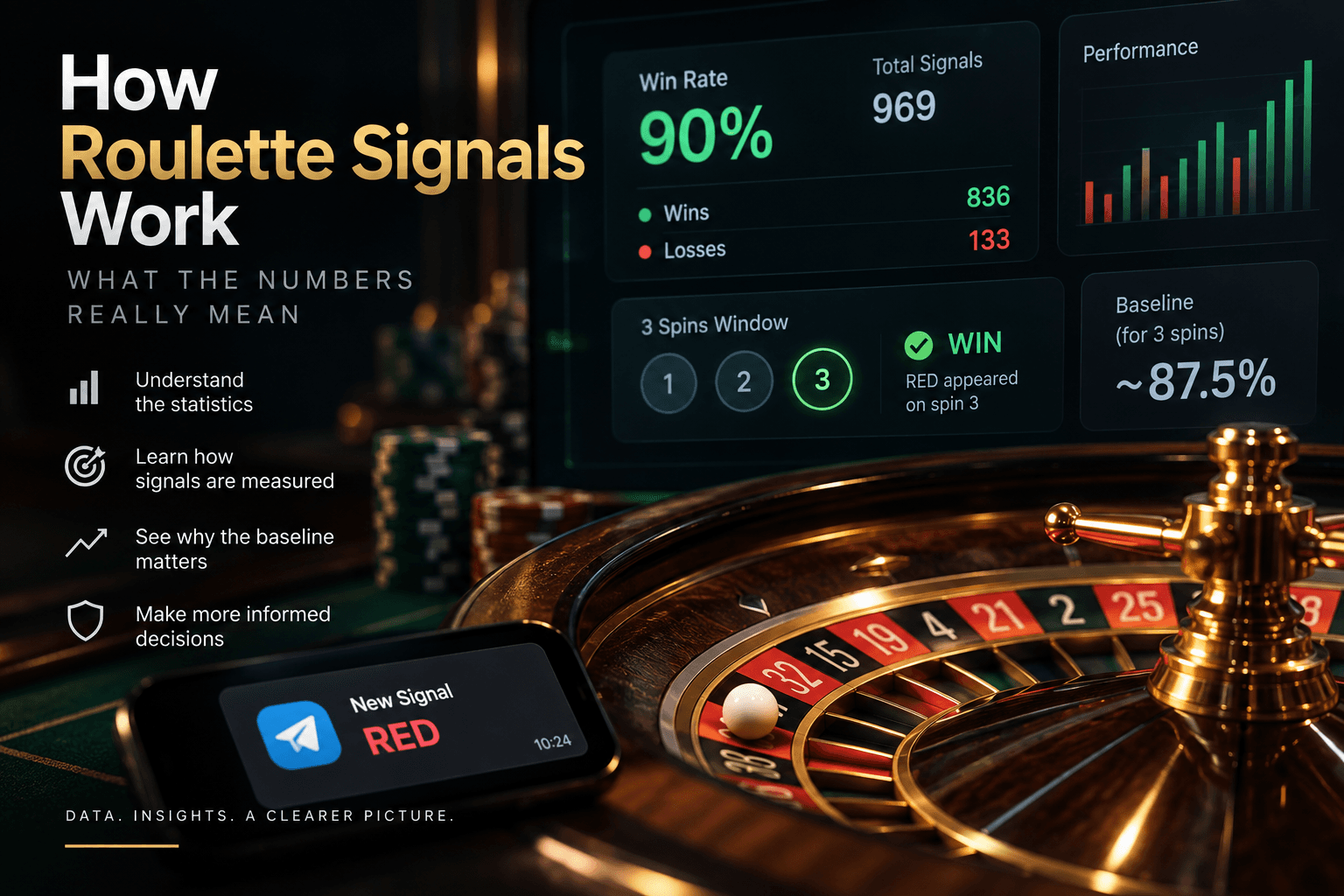
For example, a RED signal may stay active for up to 3 spins. If RED appears during that window, the signal is recorded as a win.
This naturally produces a much higher win rate than predicting the result of a single spin.
So a 90% win rate does not mean the system predicts individual roulette spins correctly 90% of the time.
Win Rate Needs a Baseline
A percentage becomes useful when you compare it with what could happen naturally under the same rules.
If a strategy already has a high probability of winning because it gets several attempts, its expected baseline will also be high.
The useful question becomes:
Does the signal consistently perform better than that baseline?
That difference is what matters when evaluating whether a signal may contain useful predictive information.
Why We Track Signals Over Time
Short winning streaks happen naturally in roulette.
A system can look extremely strong over 20, 50, or even 100 signals and still return to normal performance as more data is collected.
For this reason, our analytics track signals over longer periods and evaluate:
- total resolved signals
- wins and losses
- win rate
- signal mode
- number of spins allowed
- historical performance
- expected statistical baseline
- performance across different periods
More data gives a clearer picture of whether a result is persistent or simply short-term variance.
What About Roulette Wheel Patterns?
Physical roulette wheels can also be monitored for unusual behaviour. See how a biased roulette wheel is detected.
If a specific wheel begins producing statistically unusual results over a meaningful sample, it can be flagged for deeper analysis.
However, a pattern should not be treated as a real edge simply because it appears in recent spins.
It needs enough data and continued validation before it becomes meaningful.
How to Read Roulette Predictor Statistics
When you see performance statistics, don't look only at the headline win rate.
Check the number of signals, the evaluation window, the historical period and the expected baseline.
A large dataset performing consistently above its baseline is much more interesting than an extremely high win rate produced by a small sample.
Our goal is simple: show the data clearly and let the numbers speak for themselves.
Do Roulette Predictors Actually Work?
Most roulette predictor apps and software promise to name the next number, or the next colour, ahead of the spin. They claim win rates of 80% to 95%.
Those claims fail for two reasons.
- Every spin is independent. A regulated wheel or random number generator has no memory. Nothing in the last 50 results changes the next one. A European wheel returns 97.3% of the stake over time, and no tool alters that.
- The headline rate usually covers several spins. A signal that stays open for 3 spins wins 86.5% of the time by chance alone. A predictor that reports 87% on that window has found nothing.
So the honest answer is that a predictor cannot tell you what the next spin will be. Golden Zero does not try to. It records live streaks on real tables, sends an alert when one reaches a set length, and then publishes whether the signal won or lost.
Questions to Ask Before You Trust Any Predictor
- How many signals are behind the win rate?
- How many spins does each signal get?
- What is the win rate you would expect by chance on that window?
- Are losses published, or only wins?
- Does the result hold on data collected after the tool was released?
If a tool cannot answer all five, the percentage on its homepage tells you very little.
Keep Reading
- How to predict roulette numbers: hot and cold numbers explained
- Roulette predictor: can roulette be predicted?
- How roulette signal alerts work
- Roulette odds vs win rate: why 90% isn't always an edge
- Do roulette systems work? Why 20 wins prove nothing
Roulette remains a game of chance. Historical performance and statistical patterns do not guarantee future results.