
Do Roulette Systems Work? Why 20 Wins Prove Nothing
A winning streak can look like a powerful signal. But how much data do you actually need before the results become meaningful?
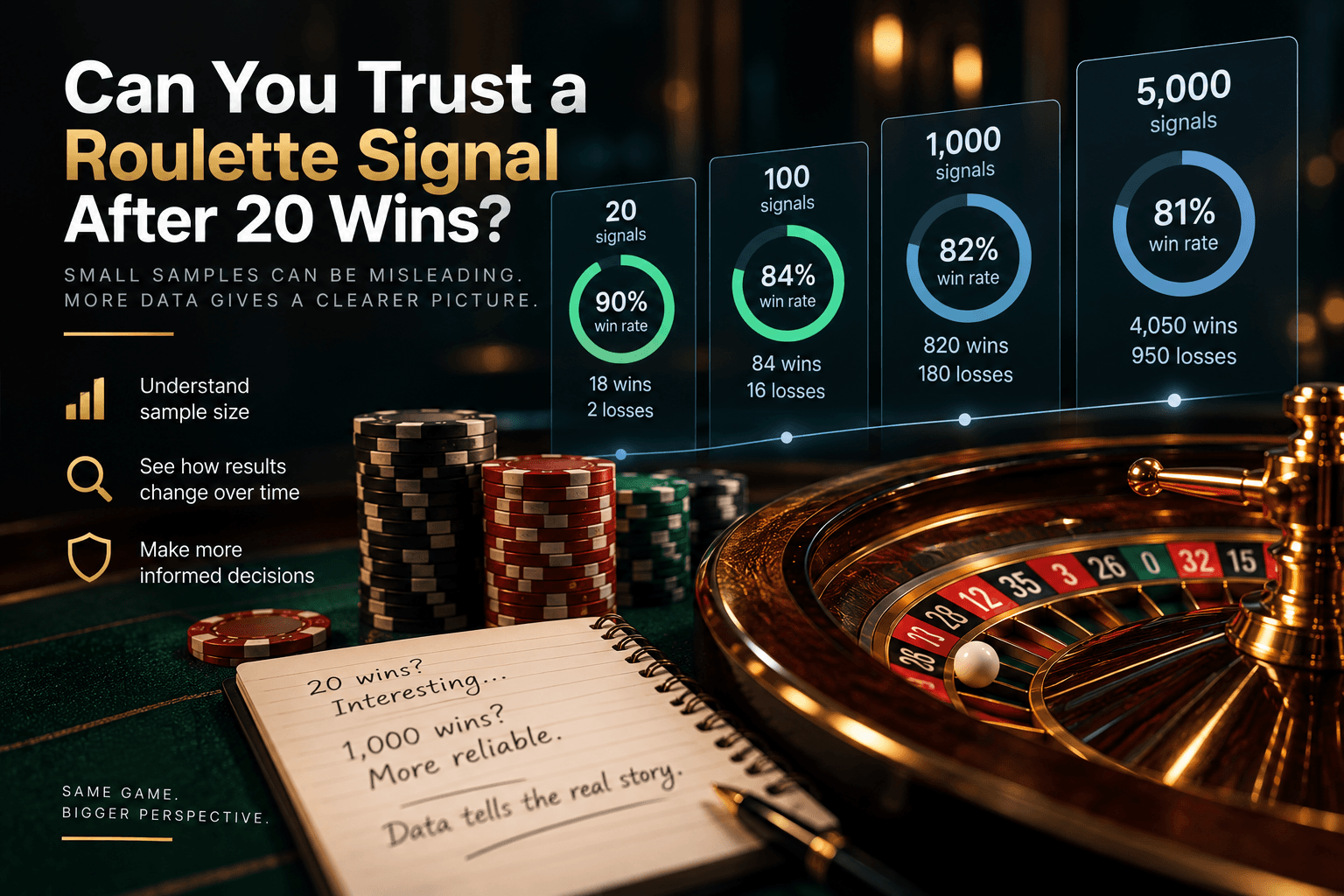
You discover a new roulette signal.
The results look great:
20 signals. 18 wins. 90% win rate.
Would you trust it?
Probably not yet.
Small Samples Can Look Incredible
Roulette naturally produces streaks.
Over a short period, almost any strategy can produce impressive results.
You might see:
- 9 wins from 10 signals
- 18 wins from 20
- several wins in a row
- one table outperforming every other table
These results are interesting, but they aren't enough by themselves to prove that you've found a repeatable pattern.
What Happens When More Data Arrives?
Imagine a signal starts with:
18 / 20 wins — 90%
After 100 signals:
84 / 100 — 84%
After 1,000 signals:
820 / 1,000 — 82%
The strategy didn't necessarily become worse.
The larger dataset simply gave us a more reliable estimate of its actual performance.
This is why we don't evaluate signals from a handful of successful predictions.
More Signals = More Confidence
Sample size tells us how much evidence sits behind a percentage.
Compare:
90% from 20 signals
with:
90% from 5,000 signals
The percentage is identical.
The amount of evidence behind it is completely different.
Time Matters Too
There is another problem.
A signal might perform well for several days or weeks and then disappear.
That's why useful analysis should look at performance across different periods rather than only lifetime statistics.
We want to know:
- How many signals were generated?
- How long has the pattern existed?
- Does it survive new data?
- Does it work across different periods?
- How does it compare with the expected baseline?
Testing Roulette Systems on New Data
The same test applies to any roulette system or strategy that claims to work. Finding a promising pattern is only the beginning.
A signal becomes more interesting when new, previously unseen results continue to support it.
That's why our system keeps collecting data even after a strategy looks strong.
The objective is not to find the highest percentage on the dashboard.
It's to determine whether the pattern survives when more evidence arrives.
Why No Betting System Beats the House Edge
Martingale, Fibonacci, D'Alembert and the dozen systems all change how much you stake after a win or a loss. None of them changes the odds of a spin.
On a European wheel every bet carries the same 2.70% house edge. Stake 100 units in total and you lose 2.70 on average, whatever pattern you used to size the bets. A betting system reshapes variance. It gives you many small wins and a rare large loss, or the reverse. The expected loss per unit staked stays the same.
That is why a system can look perfect for 20 sessions and still fail. The failure arrives as one long losing run that hits the table limit or empties the bankroll.
How Much Data Is Enough?
Sample size sets how wide the margin of error is. Take 18 wins from 20 signals (90%):
- With 20 signals, the true win rate could plausibly sit anywhere between about 70% and 97% (95% confidence, Wilson interval).
- With 4,500 wins from 5,000 signals, the same 90% narrows to about 89% to 91%.
The first result is a hint. The second is a measurement. Both show the same percentage on a dashboard.
How to Spot a Roulette System Scam
Most paid "systems that work" share the same tells:
- A guaranteed or near-certain win rate.
- Screenshots of a short winning window, with no full history.
- No stated baseline, so the percentage has nothing to be compared against.
- Results measured over several spins per signal, which inflates the rate (see roulette odds vs win rate).
- No results on data collected after the system was published.
A real test publishes every signal, states the evaluation window, and keeps counting after the first good run.
Keep Reading
- How to predict roulette numbers: hot and cold numbers explained
- The gambler's fallacy in roulette
- Roulette odds vs win rate
- Roulette dozen strategy and the Martingale
- Roulette predictor: can roulette be predicted?
Roulette remains a game of chance. Historical results and statistical patterns do not guarantee future outcomes.