
The Gambler's Fallacy in Roulette: Why Winning Streaks Fool You
Five, ten, or even twenty wins in a row can feel like a pattern. Learn why streaks happen naturally and how data helps separate real signals from random variance
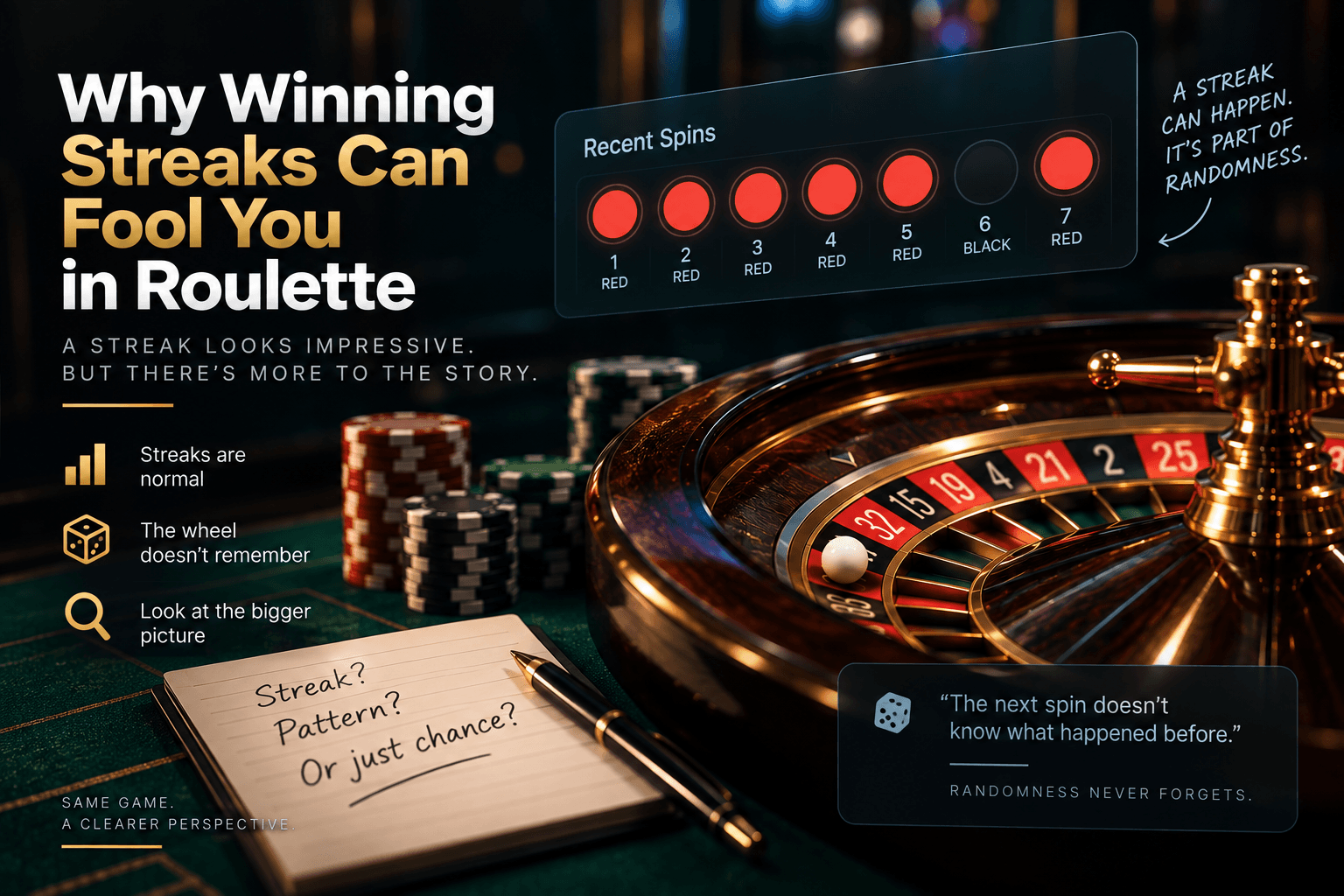
You watch a roulette table and notice something unusual:
🔴 RED 🔴 RED 🔴 RED 🔴 RED 🔴 RED
Five reds in a row.
It immediately feels like something is happening.
Maybe the wheel has a pattern. Maybe RED is unusually strong. Or maybe BLACK is now “due.”
But a streak alone doesn't tell us any of those things.
Streaks Are Normal
Randomness doesn't produce perfectly balanced sequences.
If you watch enough roulette spins, you will naturally see:
- several reds in a row
- long black streaks
- repeated numbers
- unusual-looking sections of the wheel
- periods where one outcome appears much more frequently
These sequences can look meaningful even when they are produced entirely by chance.
The Gambler's Fallacy: What Happens After 5 Reds?
A common reaction is to think:
“BLACK has to come next.”
This belief is the gambler's fallacy. The previous five spins don't force the next spin to compensate.
On a standard European roulette wheel, the next spin still has:
- 18 red numbers
- 18 black numbers
- 1 green zero
The wheel doesn't remember what happened before.
What About 10 or 20 Wins?
This becomes more interesting.
Imagine a signal produces:
10 wins in a row.
That deserves attention, but it still isn't enough to establish a reliable pattern.
Even unlikely sequences eventually appear when you observe enough tables, signals and spins.
This creates a major analytical trap.
If you monitor hundreds of possible strategies, eventually some of them will look exceptional purely by chance.
A Pattern Needs to Survive
When our system detects unusual performance, we don't judge it only by the winning streak.
We continue tracking what happens next.
We look at:
- how many signals were generated
- how performance compares with its expected baseline
- whether the pattern continues with new data
- whether performance remains consistent over time
- whether the result appears independently on future spins
A promising signal becomes much more interesting when it continues working after it has already been identified.
Why New Data Matters
Suppose we discover a strategy after it wins 18 of its last 20 signals.
Those 20 signals helped us find the strategy.
Now imagine the next 500 signals also perform unusually well.
That new data provides much stronger evidence because the pattern was identified before those results occurred.
This is why prospective testing matters.
Don't Chase the Streak
A streak is something to investigate, not proof of an edge.
The longer we collect data, the easier it becomes to distinguish temporary variance from persistent behaviour.
When evaluating roulette statistics, always look beyond the latest winning run.
Streak + sample size + baseline + future performance gives a much clearer picture.
The Monte Carlo Fallacy: 26 Blacks in a Row
The gambler's fallacy is also called the Monte Carlo fallacy, after a night in 1913 at the Monte Carlo casino. The ball landed on black 26 times in a row. Players kept betting on red, convinced a break was overdue, and lost heavily.
On a European wheel the chance of 26 blacks in a row is about 1 in 137 million. It still happened once, because enough spins happen across enough tables. Each spin remained 18 in 37 for black throughout.
Gambler's Fallacy vs Hot Hand
The gambler's fallacy has a mirror image. The hot hand fallacy is the belief that a streak will continue because the wheel is "running red".
Both assume the past changes the next spin. On a fair wheel it does not, in either direction. The only case where a streak says something is when the wheel itself is flawed, which takes thousands of spins to show (see how a biased wheel is detected).
How to Test a Streak Yourself
- Write down the rule before you look at results, for example "bet black after 5 reds".
- Record every instance, wins and losses, with no cherry-picking.
- Compute the chance of winning by luck for your bet.
- Compare the two over a few thousand instances, on spins that came after you wrote the rule.
Most "streak systems" return the chance rate and then drift below it once the house edge is counted.
Keep Reading
- How to predict roulette numbers: hot and cold numbers explained
- Best baccarat strategy: banker vs player odds
- Roulette streak odds: how long can a streak last?
- Do roulette systems work? Why 20 wins prove nothing
- Is roulette rigged? Biased roulette wheels explained
- Roulette odds, streak probability and house edge
Roulette remains a game of chance. Historical patterns, streaks and statistical analysis cannot guarantee future outcomes.